Opening Rankbank0.0s
Getting startedCreating your Rankbank accountAdding your first websiteProving your site is yoursWriter view and Site owner viewHow Rankbank tells you thingsYour dashboardRankbank Pro and billing
Site audit & search growthThe SEO overview, explainedHow Rankbank reads your siteThe site health scoreThe Problems to fix pageEvery problem type, explainedYour fix listFindings: how to read a cardEverything Rankbank looks forThe map of your siteConnecting Google Search ConsoleThe growth planSuggested linksTopics and content ideasAuthority: how much weight your site carriesThe Search traffic pagePast reads and history
Guest postsGuest posting on RankbankSubmitting your first guest postImporting from Google DocsWriting in the Rankbank editorReview & send: the last step before the editorsWhen the editors ask for changesTracking your guest postsFor site owners: opening your site to guest postsFor site owners: writing your guidelinesFor site owners: reviewing a submissionFor site owners: publishing and the live checkThe Content Library
Link exchangeLink swaps on RankbankSetting up your site for swapsPages you shareFinding a site to swap withSending a swap requestReviewing a swap request you receivedAsking a partner for a linkAnswering a link requestWhen the page is published somewhere you can't editHow Rankbank keeps watchThe partner ledger
Content calendarThe content calendarSetting up your calendarWhere the keywords come fromReading the calendarSteering an article before it's writtenReviewing and editing a draftConnecting where it publishesPublishing and what happens nextStyle & settings
TutorialsYour first site audit, from "read my site" to fixes you can ship this weekConnecting Search Console and turning its data into clicksWriting a guest post that gets accepted, the full pathRunning guest posts on your site without letting quality slipYour first link swap, start to finishKeeping your links alive, from wording changes to missing linksA month of content on autopilot, done properly
RankbankHelp center
Open Rankbank →
Getting startedCreating your Rankbank accountAdding your first websiteProving your site is yoursWriter view and Site owner viewHow Rankbank tells you thingsYour dashboardRankbank Pro and billing
Site audit & search growthThe SEO overview, explainedHow Rankbank reads your siteThe site health scoreThe Problems to fix pageEvery problem type, explainedYour fix listFindings: how to read a cardEverything Rankbank looks forThe map of your siteConnecting Google Search ConsoleThe growth planSuggested linksTopics and content ideasAuthority: how much weight your site carriesThe Search traffic pagePast reads and history
Guest postsGuest posting on RankbankSubmitting your first guest postImporting from Google DocsWriting in the Rankbank editorReview & send: the last step before the editorsWhen the editors ask for changesTracking your guest postsFor site owners: opening your site to guest postsFor site owners: writing your guidelinesFor site owners: reviewing a submissionFor site owners: publishing and the live checkThe Content Library
Link exchangeLink swaps on RankbankSetting up your site for swapsPages you shareFinding a site to swap withSending a swap requestReviewing a swap request you receivedAsking a partner for a linkAnswering a link requestWhen the page is published somewhere you can't editHow Rankbank keeps watchThe partner ledger
Content calendarThe content calendarSetting up your calendarWhere the keywords come fromReading the calendarSteering an article before it's writtenReviewing and editing a draftConnecting where it publishesPublishing and what happens nextStyle & settings
TutorialsYour first site audit, from "read my site" to fixes you can ship this weekConnecting Search Console and turning its data into clicksWriting a guest post that gets accepted, the full pathRunning guest posts on your site without letting quality slipYour first link swap, start to finishKeeping your links alive, from wording changes to missing linksA month of content on autopilot, done properly
  1. Help center
  2. /
  3. Getting started
  4. /
  5. Writer view and Site owner view

Writer view and Site owner view

Updated August 24, 2026


Rankbank does two fairly different jobs. It helps writers get articles published on other people's sites, and it helps site owners fix, grow, and trade links with sites of their own. Plenty of people do both. Showing every module to everyone made the sidebar a wall, so there is a switch in the header that picks which half you are looking at.

Where the switch is

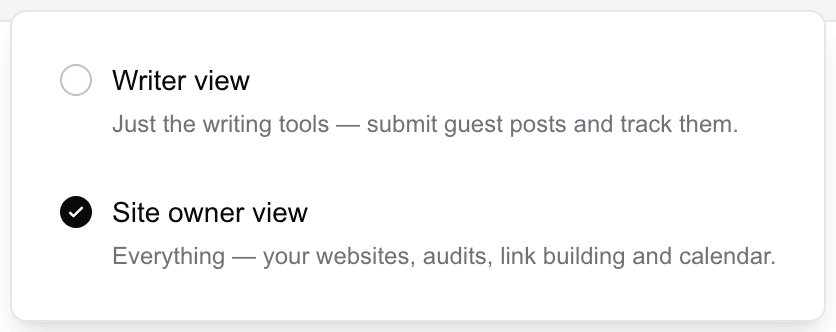
Top right of every page, to the left of the notification bell and the light and dark toggle. It shows the view you are in now, with a small chevron. Click it and both options open with their descriptions attached, because a switch nobody can decode is worse than no switch at all.

Writer view: "Just the writing tools — submit guest posts and track them."

Site owner view: "Everything — your websites, audits, link building and calendar."

The one you are in has a filled dot next to it.

The header view switch open, showing Writer view and Site owner view with their descriptions
Both options carry their own one-line description, so the switch explains itself the first time you open it.

What each view shows

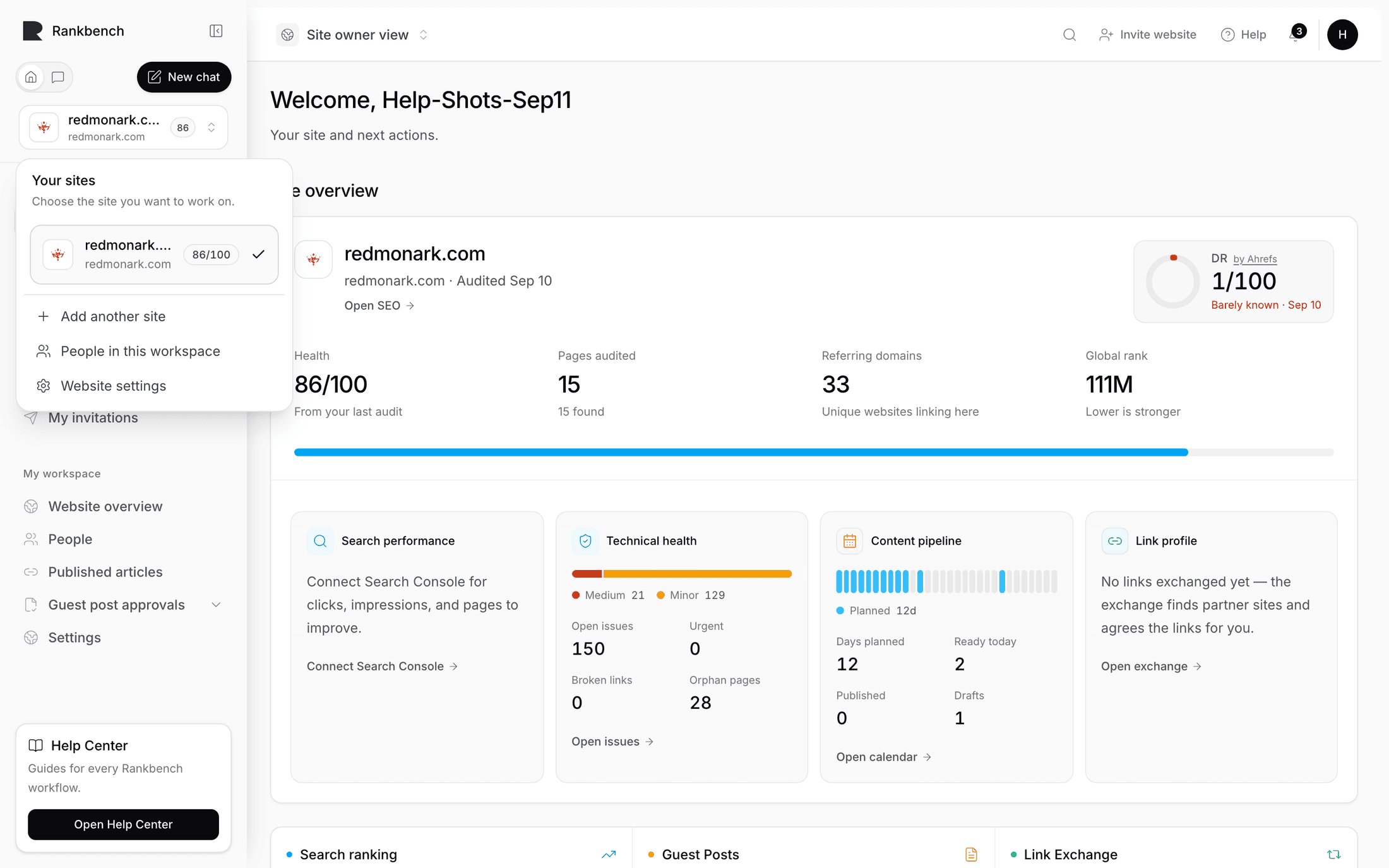
Site owner view shows the whole sidebar in a fixed order: Dashboard, Blogs & Articles (Content Calendar, Articles History, Integration), Link Exchange, Guest Posts, SEO, and My site, plus the admin sections your role gives you.

Writer view trims the sidebar to the writing path:

  • Get started (until you answer the first-run question)
  • Dashboard
  • Guest Posts, with its three entries: Submit Guest Post, My Guest Posts, Content Library
  • Notifications
  • Profile

That is the complete list of what a guest author actually needs. Everything else is one switch away.

It is a lens, not a permission

This is the part worth internalising, because the switch looks like a role selector and is not one.

Switching is always allowed. Nothing asks whether you are entitled to site owner view, and nothing is unlocked by choosing it. All the switch does is decide which menu items are drawn. What your account may actually do comes from your workspace membership and role, and that is enforced by every page independently of which view you happen to be in.

The practical consequences:

  • A guest author who flips to site owner view sees more menu items, opens one, and gets the page's own answer, which is usually an invitation to add a site.
  • A site owner who flips to writer view has lost nothing. Their sites, audits and swaps are all still there, one switch away.
  • Nothing you started in one view disappears in the other. It is the same account looking at the same data.

Which view you start in

Accounts with a workspace start in Site owner view. Accounts without one, which is what you get if you registered as someone who writes for other people's sites, start in Writer view.

After that, your choice is remembered in your browser, so it persists between visits on that device. Sign in somewhere else and you get the default again for your account type.

Who each view suits

Writer view suits you if you write articles that other people publish. Freelancers, agency writers, anyone building links back to a client's site. The five sidebar entries cover the whole job: start a post, track its review, collect the verified ones.

Site owner view suits you if you run a site. Audits, problems to fix, the growth plan, link swaps, guest posts arriving at your site, the content calendar. It is more surface area, and it is all attached to sites you own.

Both, switching between them, suits consultants and in-house marketers who write for other sites while running their own. Use writer view on the days you are writing, owner view on the days you are fixing, and stop scrolling past nine menu groups to reach the two you want.

The account label underneath

At the bottom of the sidebar, under your name, is a short label. It is not the view you are in; it is what your account is.

If you have a role in an organisation, the label is that role. If your account is a site-owner account without a role assigned yet, it reads Website owner. If your account has no organisation at all, it falls back to Guest Author, and the line under your name in the opened menu reads "Public contributor account" where an organisation name would sit.

That label does not change when you flip views. A guest author browsing in site owner view is still a guest author, and the sidebar keeps saying so.

Where to go next

If you are in writer view and wondering what happens next, read guest posting on Rankbank. If you are in site owner view and your first site is not in yet, start with adding your first website. Either way, your dashboard is the page that adapts to whatever you have in flight.

← Proving your site is yoursHow Rankbank tells you things →

Still stuck?

Open Rankbank and the page this article describes — most screens explain themselves as you go.

On this page

Where the switch isWhat each view showsIt is a lens, not a permissionWhich view you start inWho each view suitsThe account label underneathWhere to go next
Rankbank — Editorial collaborationOpen RankbankHelp home