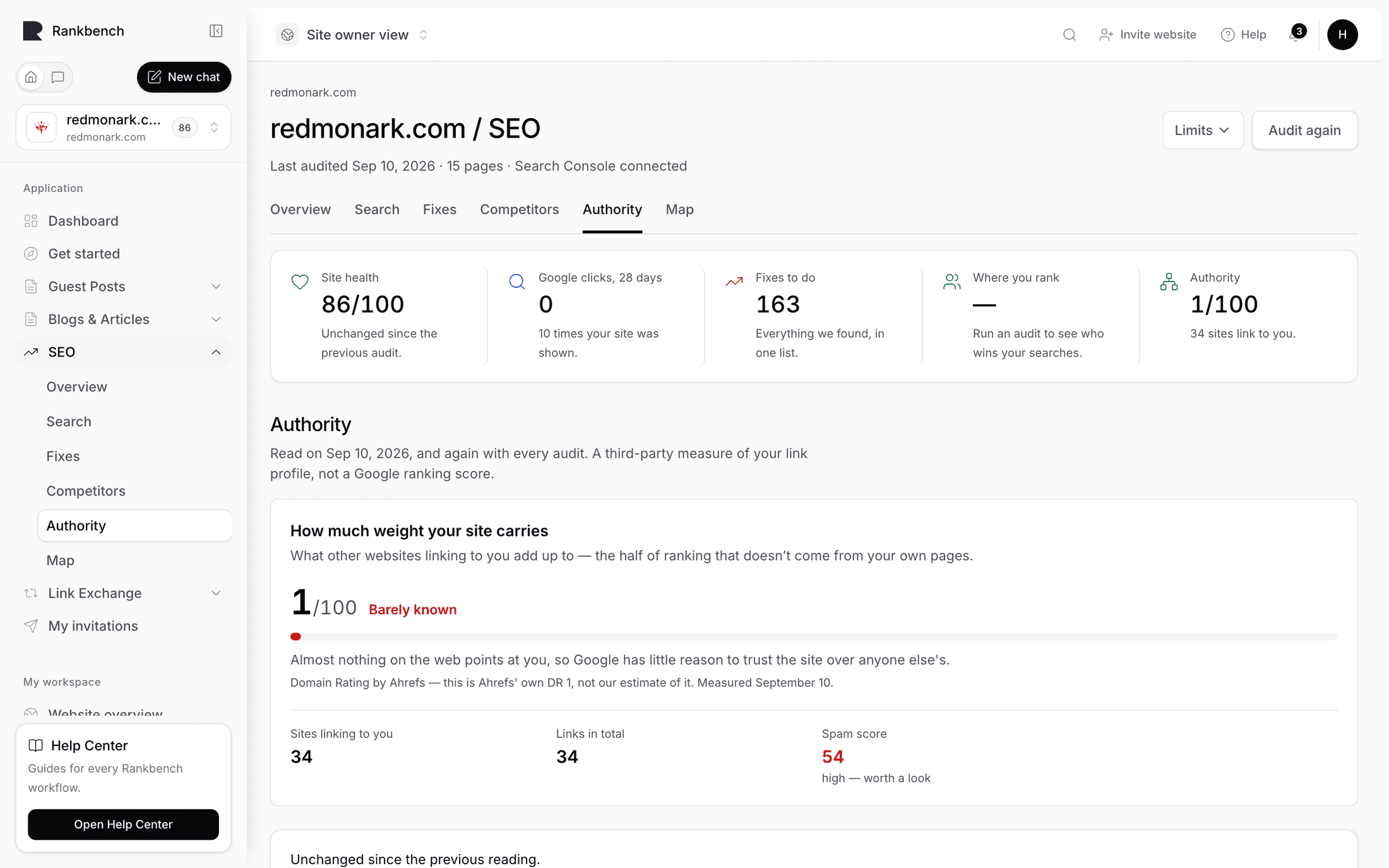
Authority: how much weight your site carries
Updated August 24, 2026
Authority is the half of ranking that doesn't come from your own pages.
Everything else in this module is about your site: your titles, your links between your pages, your content. Authority is a judgement the rest of the web passes on you. It goes up when other websites link to yours, and there is no way to write your way to it.
The panel puts it in one line: "What other websites linking to you add up to — the half of ranking that doesn't come from your own pages."
Why it matters more than it looks
A site sitting at 3/100 can rewrite every title it owns, fix every broken link, and still lose to a heavier competitor for the same search with a worse page. That's not unfair, it's how the system works: Google trusts a domain roughly in proportion to how many other sites vouch for it.
Which is why authority sits high on your Overview rather than at the bottom, and why it reads as a meter rather than as another stat tile. The tiles at the top of that page count things your site did. This one number is a verdict passed on it.
It's also the ceiling on everything else. When your growth plan is empty and you're wondering what's left, this is the answer.
The meter and the five bands
A number out of 100, a coloured bar, and a band with a sentence. The band is the point, because "authority 12/100" means nothing on its own.
| Band | Range | What it means |
|---|---|---|
| Barely known | Under 10 | "Almost nothing on the web points at you, so Google has little reason to trust the site over anyone else's." |
| Low | 10 to 24 | "Enough to rank for specific, uncontested searches. Not enough to win anything competitive yet." |
| Getting somewhere | 25 to 44 | "A real foundation. Pages you write now stand a chance without needing links of their own." |
| Solid | 45 to 64 | "Search engines trust the domain. Most of what holds a page back now is the page itself." |
| Strong | 65 and above | "Weight most sites never reach. New pages here tend to rank on the strength of the domain alone." |
The boundaries are generous at the bottom on purpose. The difference between 2 and 8 is nothing anybody can feel. The difference between Barely known and Getting somewhere is the whole story of a first year of link building.

Warning
Authority has five named bands. The site health score has none, deliberately. They measure different things and are not comparable. A brand-new site with clean HTML can sit at 95 health and 3 authority, and that combination is completely normal.
Under the number, when there's a previous reading to compare against and the change is at least 2 points, a small line reads "up 4 since the last reading" or "down 3 since the last reading". Smaller movements aren't shown, because a one-point wobble in a third-party estimate is not news.
Before anything has been measured, the panel says: "Measured within the hour of a site being added — nothing to show yet."
The four figures
| Figure | What it says |
|---|---|
| Sites linking to you | "How many different websites link to this domain. Variety matters far more than raw link count." |
| Links in total | "Every link pointing here, including several from the same site." |
| Rankbank score | "Our own estimate from public signals — a compass, not a guarantee." |
| Spam score | "How risky the links pointing at this domain look. Lower is safer." |
Sites linking to you is the number to grow. Ten links from ten different sites beat a hundred from one, and the hint says so. When Rankbank tells you that "the first ten referring domains matter far more than the next hundred", this is the figure it's talking about.
Rankbank score is described as a compass rather than a guarantee, which is the right way to read any third-party authority number, including the big ones. It's an estimate from public signals. Use it to see direction, not to make promises.
Spam score stays plain until it's worth acting on. At 10 or above it turns amber with the note "worth watching". At 30 or above it turns red with "high — worth a look". Under 10 it's left uncoloured, because painting an ordinary number red teaches you to ignore the colour on the day it matters.
A high spam score usually means links from directories, scraped sites or link farms rather than anything you did. It's worth a look rather than a panic.
The refresh rhythm
The Refresh status card says: "We refresh these numbers for you on a schedule — no setup needed." Underneath: Last updated and Next refresh window.
There's also a Refresh authority button for when you want it sooner. The minimum interval is 24 hours, so if you press it inside that window you get "Authority intelligence is already current." rather than a spinner and a fresh identical number.

Once a day is the right ceiling. Authority moves on the timescale of link building, which is weeks and months. A number that changed since yesterday morning changed because the provider recalculated, not because your site did something.
Strongest known pages
Below the panel, up to 25 of your own pages with page-level authority, each showing Trust {n}/100, Rankbank score {n}/100, and how many referring domains point at that specific page.
Most sites will see the empty state instead:
No page-level external authority. The current authority provider has not supplied reliable URL-level metrics. RankBank will not invent page authority from domain data.
That last sentence is a deliberate refusal, and it's worth understanding. It would be easy to take your domain authority, spread it across your pages by some formula, and print a number on each. Plenty of tools do. It would also be made up, and you'd make decisions on it. Rankbank shows nothing rather than showing something invented.
If the whole authority provider is switched off for your workspace, a different empty state appears: Authority numbers aren't switched on, with "Everything else in your audit works without them — this page just stays empty."
Authority distribution opportunities
The last section lists source-to-target pairs derived from your internal structure: pages of yours carrying weight that could be passing more of it to pages that need it. It's the internal counterpart to everything above, and it overlaps with what suggested links proposes.
The Show on the map button at the top of the page opens the map of your site already in Authority view mode, which is the fastest way to see which pages are hoarding and which are starved.
What actually moves this number
Two things, and only two things: more websites linking to you, and better websites linking to you.
Rankbank runs both routes in the same app, which is why the findings about authority end in a button rather than a shrug.
Link swaps. You find a site in your field, agree to link to each other, and both sides place the link themselves. Every live link is checked and re-checked, so you find out if a partner quietly drops yours. Start with link swaps on Rankbank, then setting up your site for swaps and finding a site to swap with. If you'd rather follow one worked example, your first link swap, start to finish does the whole thing.
Guest posts. You write an article for a site that already ranks in your field, they publish it, and you earn the link. Rankbank verifies the live page afterwards. Start with guest posting on Rankbank and submitting your first guest post.
Two findings will push you at both. Nobody links to you fires when a site with at least five pages has zero referring domains. Little weight with search engines fires when a site with at least twenty pages sits under 20/100. Both carry a callout with links straight into the directory and the guest-post side. See the finding catalog.
Set expectations accordingly. The finding about competitors says it best: "Authority moves over months, not days. It is the ceiling on everything else, which is why it is worth starting now."
Still stuck?
Open Rankbank and the page this article describes — most screens explain themselves as you go.