Opening Rankbank0.0s
Getting startedCreating your Rankbank accountAdding your first websiteProving your site is yoursWriter view and Site owner viewHow Rankbank tells you thingsYour dashboardRankbank Pro and billing
Site audit & search growthThe SEO overview, explainedHow Rankbank reads your siteThe site health scoreThe Problems to fix pageEvery problem type, explainedYour fix listFindings: how to read a cardEverything Rankbank looks forThe map of your siteConnecting Google Search ConsoleThe growth planSuggested linksTopics and content ideasAuthority: how much weight your site carriesThe Search traffic pagePast reads and history
Guest postsGuest posting on RankbankSubmitting your first guest postImporting from Google DocsWriting in the Rankbank editorReview & send: the last step before the editorsWhen the editors ask for changesTracking your guest postsFor site owners: opening your site to guest postsFor site owners: writing your guidelinesFor site owners: reviewing a submissionFor site owners: publishing and the live checkThe Content Library
Link exchangeLink swaps on RankbankSetting up your site for swapsPages you shareFinding a site to swap withSending a swap requestReviewing a swap request you receivedAsking a partner for a linkAnswering a link requestWhen the page is published somewhere you can't editHow Rankbank keeps watchThe partner ledger
Content calendarThe content calendarSetting up your calendarWhere the keywords come fromReading the calendarSteering an article before it's writtenReviewing and editing a draftConnecting where it publishesPublishing and what happens nextStyle & settings
TutorialsYour first site audit, from "read my site" to fixes you can ship this weekConnecting Search Console and turning its data into clicksWriting a guest post that gets accepted, the full pathRunning guest posts on your site without letting quality slipYour first link swap, start to finishKeeping your links alive, from wording changes to missing linksA month of content on autopilot, done properly
RankbankHelp center
Open Rankbank →
Getting startedCreating your Rankbank accountAdding your first websiteProving your site is yoursWriter view and Site owner viewHow Rankbank tells you thingsYour dashboardRankbank Pro and billing
Site audit & search growthThe SEO overview, explainedHow Rankbank reads your siteThe site health scoreThe Problems to fix pageEvery problem type, explainedYour fix listFindings: how to read a cardEverything Rankbank looks forThe map of your siteConnecting Google Search ConsoleThe growth planSuggested linksTopics and content ideasAuthority: how much weight your site carriesThe Search traffic pagePast reads and history
Guest postsGuest posting on RankbankSubmitting your first guest postImporting from Google DocsWriting in the Rankbank editorReview & send: the last step before the editorsWhen the editors ask for changesTracking your guest postsFor site owners: opening your site to guest postsFor site owners: writing your guidelinesFor site owners: reviewing a submissionFor site owners: publishing and the live checkThe Content Library
Link exchangeLink swaps on RankbankSetting up your site for swapsPages you shareFinding a site to swap withSending a swap requestReviewing a swap request you receivedAsking a partner for a linkAnswering a link requestWhen the page is published somewhere you can't editHow Rankbank keeps watchThe partner ledger
Content calendarThe content calendarSetting up your calendarWhere the keywords come fromReading the calendarSteering an article before it's writtenReviewing and editing a draftConnecting where it publishesPublishing and what happens nextStyle & settings
TutorialsYour first site audit, from "read my site" to fixes you can ship this weekConnecting Search Console and turning its data into clicksWriting a guest post that gets accepted, the full pathRunning guest posts on your site without letting quality slipYour first link swap, start to finishKeeping your links alive, from wording changes to missing linksA month of content on autopilot, done properly
  1. Help center
  2. /
  3. Link exchange
  4. /
  5. Finding a site to swap with

Finding a site to swap with

Updated August 24, 2026


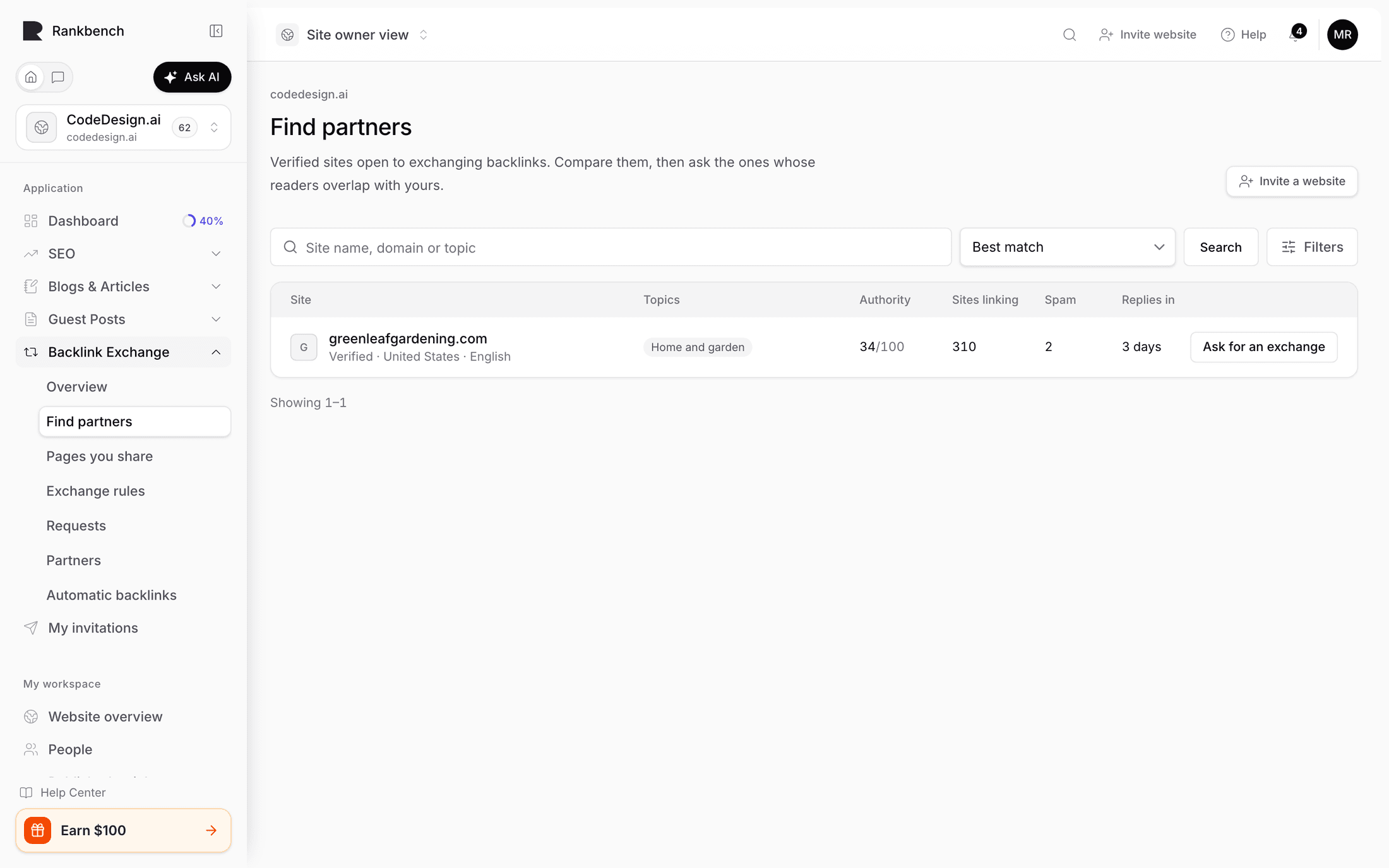
Opportunities is the directory: Find a site to swap links with. Its description sets the standard for a good choice: "These sites have said yes to swap requests. Pick one whose readers overlap with yours — that's what makes the links worth having."

Who appears here, and who does not

Nobody is listed without opting in. A site shows up only when all of these are true, which is exactly the checklist from setting up your site for swaps:

  • its organisation is active and not paused,
  • Accept Link Exchanges is on,
  • visibility is set to Public,
  • and it has a published set of swap rules.

Verified sites are listed first. If you set your own site up correctly, you are in this directory too, and other owners are reading your card the same way you are reading theirs.

There is no matchmaking. Rankbank does not rank sites by how well they suit you or push suggestions at you. What you get is a search box, four sorts, and seven filters, and the results are whatever matches.

Searching

The search box takes "A site name, domain, or topic". Start there. The filters are folded away behind a disclosure for a reason, and the reason is printed on it: "Optional filters. Most people find a partner with search alone."

Next to the box is Sort by with four options.

  • Best match is the default and orders by how well results fit your search.
  • Strongest sites first orders by authority.
  • Most sites linking to them orders by referring domains, which is the count of distinct websites pointing at a domain.
  • Newest here orders by when the site joined, which is where you find people actively looking for their first partners.

Press Search to apply.

The Opportunities directory with the search box, sort control, and several site cards
The directory. Every site here has said yes to swap requests.

Narrowing it down

Open the Narrow it down disclosure ("Category, country, language, quality thresholds.") for the precision filters.

  • Category and Country and Language come from the details each owner set on their site.
  • Verification filters on Any status, Verified, Pending, or Unverified.
  • Authority at least offers Any, then 20 / 100 through 70 / 100.
  • Sites linking to them, at least offers Any, 10, 50, 100, 500, or 1,000.
  • Replies within (days) is a number, matched against the owner's own Expected review days setting.

Press Apply filters.

The Narrow it down disclosure open, showing category, country, language, verification, and threshold filters
Seven filters, folded away by default so results come first.

Tip

Resist the urge to set the authority floor as high as it will go. A site far stronger than yours is likely to have a minimum you do not clear, and the request will be blocked before it is sent. Swaps are worth most between sites of similar strength, which is what the comparison card on the request page is trying to tell you.

Reading a card

Each result is one site. The heading is the website's name; underneath it is the organisation and the root domain. Then a row of small chips: the target country, the primary language, either Verified or Verification pending, and the categories the owner chose.

Below that is the metrics strip, the same one used everywhere else in Rankbank, showing whichever of these figures are known.

  • Authority out of 100. Its tooltip says "How strong this domain looks to search engines, out of 100. Higher means a link from it counts for more."
  • Sites linking to it, with the reminder that "Variety matters more than raw link count."
  • Total links, which counts several links from the same site separately.
  • Spam score. "Lower is safer — practitioners usually want under 5."
  • Monthly search visits, an estimate of visitors from Google.

A newly added domain may show "Metrics coming shortly — we check new sites within the hour." rather than numbers. That is normal and it does not block anything.

Two more lines can appear at the bottom of a card. "Usually replies in {n} days" comes straight from that owner's Expected review days setting, so read it as their intention rather than a guarantee. Paid Collaboration Available means the owner has ticked that they are open to paid arrangements; Rankbank handles no money and takes no part in that.

When you have found a site you like, press Ask to swap links. That takes you to the request page with their site already selected. See sending a swap request.

Nothing matched

The empty state reads "No sites matched — Try a broader search — or, if you already know who you want to swap with, invite them. It's free for them to join."

Widen before you narrow. Clear the filters first, then shorten the search term, then try the category filter alone.

Inviting a site that is not here

Most of the web is not on Rankbank. If you already have a site in mind, press Invite a website, at the top of the directory and again next to the empty state.

The dialog is titled Invite a website to Rankbank and explains itself: "We'll make a personal invite link. Send it however you like — they see who invited them and what collaborating means, and joining is free for them."

Fill in the site's name, which is required. Leave it blank and you get "Name the website first." The website address and a personal note are optional; the note placeholder suggests the tone, "Loved your piece on… — I think our audiences overlap."

Then the result panel appears: Your invite is ready, with the advice "Send it from your own email or chat — invitations from a person get read; invitations from platforms get deleted."

The invite dialog showing the ready invite link with Copy and Done
Rankbank makes the link. Sending it is yours to do.

Warning

Rankbank does not send this invitation. Nothing is emailed by the product. Press Copy and paste the link wherever you normally talk to people. The Open a ready-written email button opens your own mail client with a draft in it; the message still leaves from your address, not from Rankbank.

Press Done to close. When they join and set their site up, they appear in the directory like anyone else and you can send the request normally.

← Pages you shareSending a swap request →

Still stuck?

Open Rankbank and the page this article describes — most screens explain themselves as you go.

On this page

Who appears here, and who does notSearchingNarrowing it downReading a cardNothing matchedInviting a site that is not here
Rankbank — Editorial collaborationOpen RankbankHelp home