Opening Rankbank0.0s
Getting startedCreating your Rankbank accountAdding your first websiteProving your site is yoursWriter view and Site owner viewHow Rankbank tells you thingsYour dashboardRankbank Pro and billing
Site audit & search growthThe SEO overview, explainedHow Rankbank reads your siteThe site health scoreThe Problems to fix pageEvery problem type, explainedYour fix listFindings: how to read a cardEverything Rankbank looks forThe map of your siteConnecting Google Search ConsoleThe growth planSuggested linksTopics and content ideasAuthority: how much weight your site carriesThe Search traffic pagePast reads and history
Guest postsGuest posting on RankbankSubmitting your first guest postImporting from Google DocsWriting in the Rankbank editorReview & send: the last step before the editorsWhen the editors ask for changesTracking your guest postsFor site owners: opening your site to guest postsFor site owners: writing your guidelinesFor site owners: reviewing a submissionFor site owners: publishing and the live checkThe Content Library
Link exchangeLink swaps on RankbankSetting up your site for swapsPages you shareFinding a site to swap withSending a swap requestReviewing a swap request you receivedAsking a partner for a linkAnswering a link requestWhen the page is published somewhere you can't editHow Rankbank keeps watchThe partner ledger
Content calendarThe content calendarSetting up your calendarWhere the keywords come fromReading the calendarSteering an article before it's writtenReviewing and editing a draftConnecting where it publishesPublishing and what happens nextStyle & settings
TutorialsYour first site audit, from "read my site" to fixes you can ship this weekConnecting Search Console and turning its data into clicksWriting a guest post that gets accepted, the full pathRunning guest posts on your site without letting quality slipYour first link swap, start to finishKeeping your links alive, from wording changes to missing linksA month of content on autopilot, done properly
RankbankHelp center
Open Rankbank →
Getting startedCreating your Rankbank accountAdding your first websiteProving your site is yoursWriter view and Site owner viewHow Rankbank tells you thingsYour dashboardRankbank Pro and billing
Site audit & search growthThe SEO overview, explainedHow Rankbank reads your siteThe site health scoreThe Problems to fix pageEvery problem type, explainedYour fix listFindings: how to read a cardEverything Rankbank looks forThe map of your siteConnecting Google Search ConsoleThe growth planSuggested linksTopics and content ideasAuthority: how much weight your site carriesThe Search traffic pagePast reads and history
Guest postsGuest posting on RankbankSubmitting your first guest postImporting from Google DocsWriting in the Rankbank editorReview & send: the last step before the editorsWhen the editors ask for changesTracking your guest postsFor site owners: opening your site to guest postsFor site owners: writing your guidelinesFor site owners: reviewing a submissionFor site owners: publishing and the live checkThe Content Library
Link exchangeLink swaps on RankbankSetting up your site for swapsPages you shareFinding a site to swap withSending a swap requestReviewing a swap request you receivedAsking a partner for a linkAnswering a link requestWhen the page is published somewhere you can't editHow Rankbank keeps watchThe partner ledger
Content calendarThe content calendarSetting up your calendarWhere the keywords come fromReading the calendarSteering an article before it's writtenReviewing and editing a draftConnecting where it publishesPublishing and what happens nextStyle & settings
TutorialsYour first site audit, from "read my site" to fixes you can ship this weekConnecting Search Console and turning its data into clicksWriting a guest post that gets accepted, the full pathRunning guest posts on your site without letting quality slipYour first link swap, start to finishKeeping your links alive, from wording changes to missing linksA month of content on autopilot, done properly
  1. Help center
  2. /
  3. Guest posts
  4. /
  5. Importing from Google Docs

Importing from Google Docs

Updated August 24, 2026


Most guest posts are written in Google Docs before Rankbank ever sees them, so importing one is the shorter of the two ways to start. You paste a share link, Rankbank fetches the document, and you land in the editor with your article already in it.

The one requirement

The document has to be readable by anyone holding the link. Rankbank fetches it as an anonymous visitor, with no Google account and no permission to ask for access. A doc shared with named people, or with your company's domain, simply is not visible to it.

In Google Docs:

  1. Open the document and press Share in the top right.
  2. Under General access, change Restricted to Anyone with the link.
  3. Leave the role as Viewer. Rankbank never writes to your document, so Editor access buys you nothing.
  4. Press Copy link, then Done.

Tip

Viewer is enough, and it is the right choice. If a link like this ever leaks, a viewer can read your draft and nothing else.

Doing the import

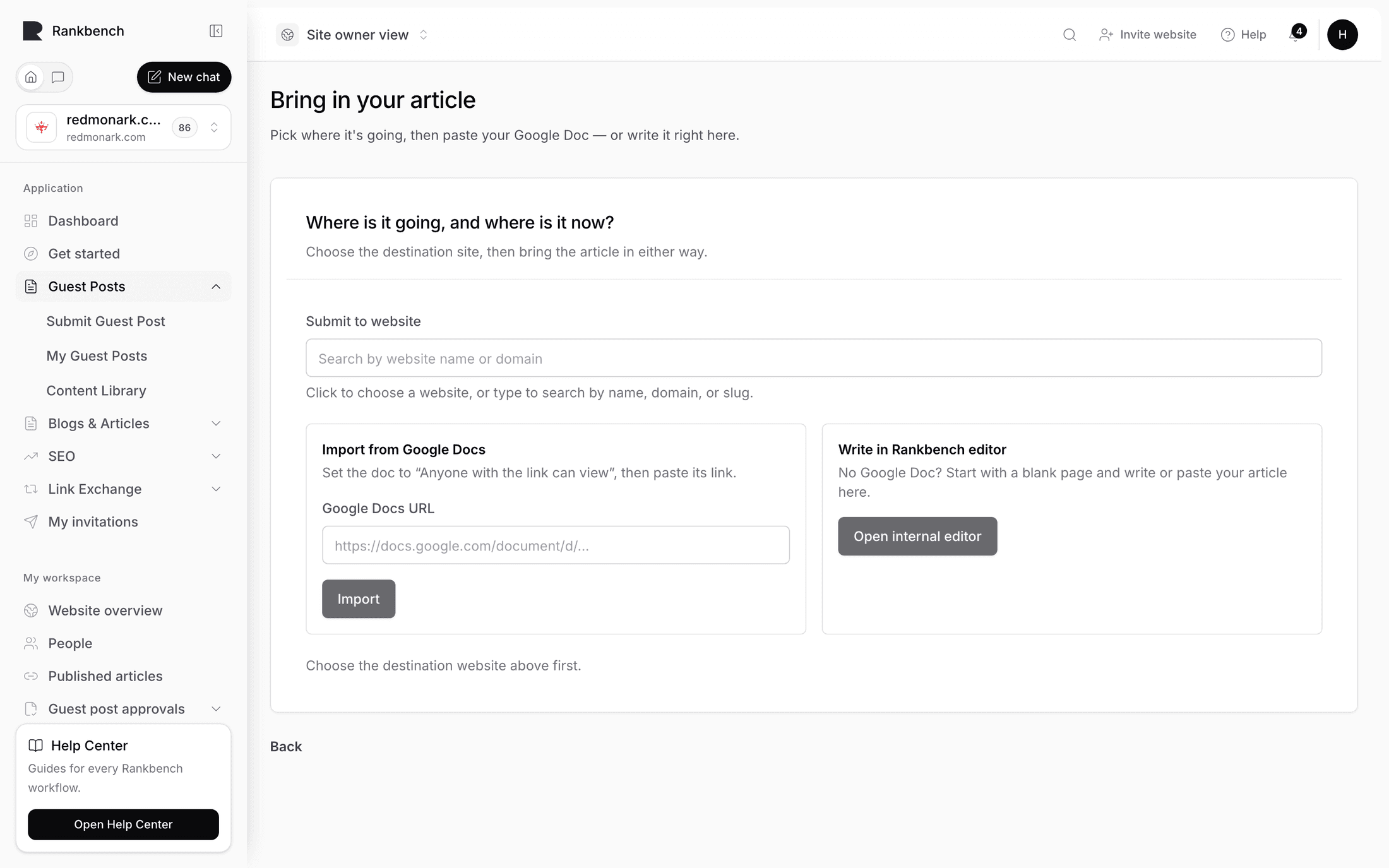
On the Submit a guest post screen, after you have chosen the destination site and ticked the agreement, the left panel of step 2 is Bring in a Google Doc. It repeats the requirement: "Paste the share link. The document must be set to 'Anyone with the link can view'."

Paste the URL into the Google Docs URL field. Rankbank accepts the ordinary document address, the one that starts https://docs.google.com/document/d/. Press Import document.

The Bring in a Google Doc panel with a document URL pasted into the Google Docs URL field and the Import document button beneath it.
The import panel. The button stays disabled until a destination site is chosen and the guidelines agreement is ticked.

A few seconds later you are in the editor with your article loaded, and Rankbank has already pulled out every link it contains.

What the import keeps

Structure, mostly. Rankbank is looking for an article, not a design.

  • Headings come through as headings. The editor only has two levels, Heading and Subheading, so a document with deeper nesting gets flattened: your Heading 4 becomes a Heading, your Heading 5 and Heading 6 both become Subheadings. Nothing is lost, but a six-level outline arrives as a two-level one.
  • The title is read from the document and put in the title field. Google Docs usually repeats that title as the first heading of the body, so Rankbank checks: if the first heading says exactly the same thing as the title, it is removed from the body. You get the title once, not twice.
  • Links survive with their wording intact, and are extracted into the list you will review before sending.
  • Images come across as images. Their captions come from the document where it has them.
  • Lists, quotes, bold and italic all come through.

What does not come through is styling. Fonts, colours, custom spacing, page breaks and comments are all dropped. Google Docs comments in particular are not imported and are not visible to anyone at the destination site.

Note

There is no file upload anywhere in this flow, and none in the editor either. Images live at a public HTTPS address or they arrive inside an imported document.

When the import does not work

A failed import sends you to a retry screen headed Bring in your article, with the subtitle "Pick where it's going, then paste your Google Doc — or write it right here." The error sits at the top in a banner titled "That import didn't work", followed by the specific reason and then the same advice every time: "Check the URL and make sure the doc is shared as 'Anyone with the link can view', then try again."

The reasons Rankbank gives are specific, so read the first sentence rather than skipping to the advice:

  • "This Google Doc is not public. Update sharing to public and try again." The sharing setting is wrong. This is the common one.
  • "Enter a valid Google Docs URL." The address is not a URL Rankbank can parse.
  • "Only public Google Docs documents are supported." The link points at something that is not a Google Doc, a Sheet or a Slide deck for instance.
  • "The Google Docs URL does not contain a valid document ID." Usually a truncated or hand-edited link. Copy it again from the Share dialog.
  • "The Google Doc did not contain importable article content." The document is empty, or everything in it lives somewhere Rankbank cannot read, such as inside an image.
  • "Google Docs did not respond in time. Try again." and "Google Docs is unavailable right now. Try again shortly." Neither is your fault. Wait a minute.
The Bring in your article retry screen with a red banner titled "That import didn't work", explaining the document is not public, above the destination picker and the URL field.
The retry screen keeps the site you picked and the URL you pasted, so a fix is one sharing change and one more press away.

The retry screen carries your destination site and the URL you tried, so fixing the sharing setting in Google and pressing Import document again is the whole recovery.

Re-importing later

The link between the article and its document does not go away after the first import.

On the article's own page you get a Re-import from Google Docs action next to Edit article and Review & send →. It appears only for articles that came from a document. It takes you back to the import screen with that document's address already filled in.

What it will not do is give you two copies of the same article. If you already have a draft from that document, importing it again returns you to the draft you already have rather than making a second one. That is a safety net against double submissions, not a way to pull fresh edits across: to move changes you made in Google Docs into a draft you have already imported, paste them into the Rankbank editor, or make the changes there in the first place.

The document connection does matter once review starts. When editors ask for changes, a Google Doc article is resubmitted by fixing the same document and pressing Resubmit my updated doc. That button does fetch the document again and files what it finds as a new version of the article. You do not paste a new link, and you do not start a new article. See When the editors ask for changes for both resubmission paths.

Warning

Keep the sharing setting as it is until the post is live. Resubmission fetches the document again, so a doc that has been locked back down mid-review cannot be resubmitted.

← Submitting your first guest postWriting in the Rankbank editor →

Still stuck?

Open Rankbank and the page this article describes — most screens explain themselves as you go.

On this page

The one requirementDoing the importWhat the import keepsWhen the import does not workRe-importing later
Rankbank — Editorial collaborationOpen RankbankHelp home