
Opening Rankbank0.0s
Getting startedCreating your Rankbank accountAdding your first websiteProving your site is yoursWriter view and Site owner viewHow Rankbank tells you thingsYour dashboardRankbank Pro and billing
Site audit & search growthThe SEO overview, explainedHow Rankbank reads your siteThe site health scoreThe Problems to fix pageEvery problem type, explainedYour fix listFindings: how to read a cardEverything Rankbank looks forThe map of your siteConnecting Google Search ConsoleThe growth planSuggested linksTopics and content ideasAuthority: how much weight your site carriesThe Search traffic pagePast reads and history
Guest postsGuest posting on RankbankSubmitting your first guest postImporting from Google DocsWriting in the Rankbank editorReview & send: the last step before the editorsWhen the editors ask for changesTracking your guest postsFor site owners: opening your site to guest postsFor site owners: writing your guidelinesFor site owners: reviewing a submissionFor site owners: publishing and the live checkThe Content Library
Link exchangeLink swaps on RankbankSetting up your site for swapsPages you shareFinding a site to swap withSending a swap requestReviewing a swap request you receivedAsking a partner for a linkAnswering a link requestWhen the page is published somewhere you can't editHow Rankbank keeps watchThe partner ledger
Content calendarThe content calendarSetting up your calendarWhere the keywords come fromReading the calendarSteering an article before it's writtenReviewing and editing a draftConnecting where it publishesPublishing and what happens nextStyle & settings
TutorialsYour first site audit, from "read my site" to fixes you can ship this weekConnecting Search Console and turning its data into clicksWriting a guest post that gets accepted, the full pathRunning guest posts on your site without letting quality slipYour first link swap, start to finishKeeping your links alive, from wording changes to missing linksA month of content on autopilot, done properly
RankbankHelp center
Open Rankbank →
Getting startedCreating your Rankbank accountAdding your first websiteProving your site is yoursWriter view and Site owner viewHow Rankbank tells you thingsYour dashboardRankbank Pro and billing
Site audit & search growthThe SEO overview, explainedHow Rankbank reads your siteThe site health scoreThe Problems to fix pageEvery problem type, explainedYour fix listFindings: how to read a cardEverything Rankbank looks forThe map of your siteConnecting Google Search ConsoleThe growth planSuggested linksTopics and content ideasAuthority: how much weight your site carriesThe Search traffic pagePast reads and history
Guest postsGuest posting on RankbankSubmitting your first guest postImporting from Google DocsWriting in the Rankbank editorReview & send: the last step before the editorsWhen the editors ask for changesTracking your guest postsFor site owners: opening your site to guest postsFor site owners: writing your guidelinesFor site owners: reviewing a submissionFor site owners: publishing and the live checkThe Content Library
Link exchangeLink swaps on RankbankSetting up your site for swapsPages you shareFinding a site to swap withSending a swap requestReviewing a swap request you receivedAsking a partner for a linkAnswering a link requestWhen the page is published somewhere you can't editHow Rankbank keeps watchThe partner ledger
Content calendarThe content calendarSetting up your calendarWhere the keywords come fromReading the calendarSteering an article before it's writtenReviewing and editing a draftConnecting where it publishesPublishing and what happens nextStyle & settings
TutorialsYour first site audit, from "read my site" to fixes you can ship this weekConnecting Search Console and turning its data into clicksWriting a guest post that gets accepted, the full pathRunning guest posts on your site without letting quality slipYour first link swap, start to finishKeeping your links alive, from wording changes to missing linksA month of content on autopilot, done properly
  1. Help center
  2. /
  3. Guest posts
  4. /
  5. Guest posting on Rankbank

Guest posting on Rankbank

Updated August 24, 2026


A guest post is an article you write that another site publishes, usually with a link back to you. The writer gets a link from a site they do not own, which is the kind of link search engines weigh most heavily. The site gets an article it did not have to write. Rankbank sits between the two and keeps a record of what was agreed, what was submitted, and what actually went live.

The deal, in plain words

You write the article. Someone else publishes it. The link inside it points back to your site.

That trade breaks down in ordinary ways. The author writes 1,500 words on a topic the site never covers. The editor asks for changes in an email thread nobody can find two weeks later. The article goes live with the link stripped out and nobody notices for a year. Every part of the flow described here exists because one of those things happened to somebody.

The four steps

Rankbank tells the story the same way on your empty My Guest Posts page, and it is worth reading once before you start:

  1. Write it. "Bring in a Google Doc or write in the editor. Everything saves as you go — a draft is never lost."
  2. Check the links. "Rankbank lists every link in your article so you can confirm each one is intentional before anyone reviews it."
  3. Send it for review. "The receiving site's editors read it against their published rules. You'll see their decision and any change requests here."
  4. It gets published. "Once approved, the site publishes it and the article's status updates on this list."
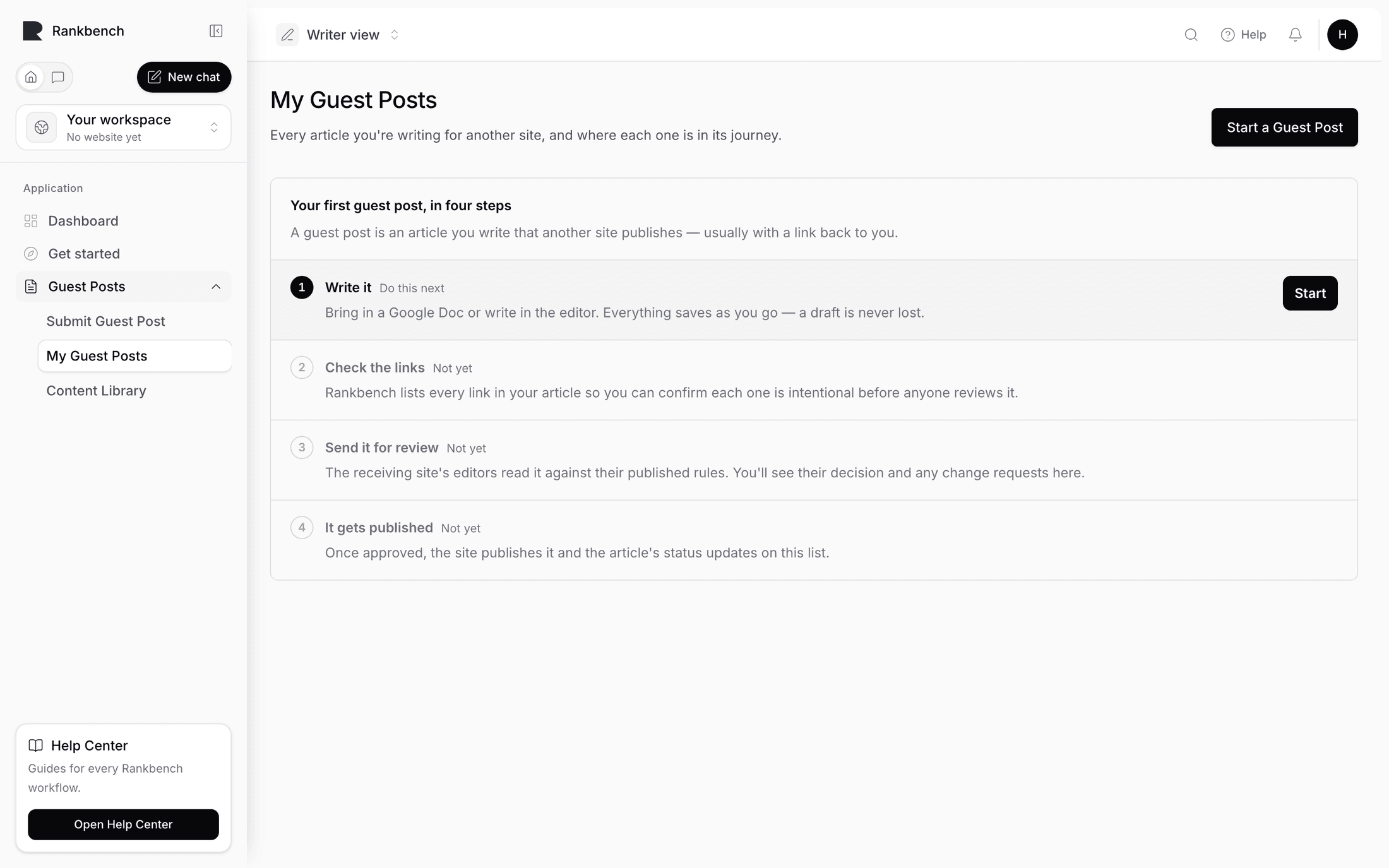
The My Guest Posts page with no articles yet, showing the card "Your first guest post, in four steps" and the four numbered stages: Write it, Check the links, Send it for review, It gets published.
Before you have written anything, My Guest Posts explains the whole journey. Once you have a post, the same four steps move behind a "How this works" disclosure.

If you are the writer

You pick the site you want to write for, agree to its published rules, then either import a Google Doc or write in Rankbank's own editor. When you are done you go to Review & send, look at your article and every link it makes side by side, and send the package to the site's editors. From then on you watch it on My Guest Posts: reviewed, changed, approved, published, checked.

You do not need an organisation or a website of your own to do any of this. An account with no workspace is a guest author account, and the sidebar labels it Guest Author. See Writer view and Site owner view if you have both jobs.

If you own the site

You turn on guest posts for your site, write the rules you want authors to follow, and publish them. From that moment your site is findable by authors and your /submit/{slug} link works. Submissions land in a review queue. You read the article, leave comments tied to the exact sentences you want changed, and approve, request changes, or reject. After you publish the article on your own site you paste the live URL back into Rankbank, which fetches the page and confirms the links are really there.

Articles 8 through 12 in this category are the owner's half of the story, and they say so.

What Rankbank does differently

Three things, and they are the reason the flow has the shape it has.

The rules come before the writing. An author sees the site's published guidelines on the submission screen, ticks a box to say they have read them, and that exact version of the rules is pinned to the submission. If the site rewrites its rules next month, your article is still judged against the version you agreed to.

Every link is shown to you before anyone else sees it. The Review & send screen renders your article with each outbound link turned into a chip, next to a table of the sites you link to. Nobody is checking up on you. The point is that you notice the stray link to a competitor before an editor does.

The live page gets verified. After the site publishes and submits the live URL, Rankbank fetches that page and compares it against the approved version: the links, their anchor text, where they point, and whether the page is indexable at all. A passing check is what turns a post Verified live and files it in your Content Library.

Note

Everything Rankbank tells you happens in the app, on the bell. There is no email in the product, so check notifications rather than your inbox.

Where things live

Under Guest Posts in the sidebar:

  • Submit Guest Post starts a new article and asks where it is going.
  • My Guest Posts lists everything you are writing and where each one is in its journey.
  • Content Library holds the posts that went live and passed their check.

Site owners get one more: Articles under the admin section, which is the review queue.

Where to start

If you are writing, read Submitting your first guest post. If you own a site and want submissions, start with opening your site to guest posts.

Submitting your first guest post →

Still stuck?

Open Rankbank and the page this article describes — most screens explain themselves as you go.

On this page

The deal, in plain wordsThe four stepsIf you are the writerIf you own the siteWhat Rankbank does differentlyWhere things liveWhere to start
Rankbank — Editorial collaborationOpen RankbankHelp home