Opening Rankbank0.0s
Getting startedCreating your Rankbank accountAdding your first websiteProving your site is yoursWriter view and Site owner viewHow Rankbank tells you thingsYour dashboardRankbank Pro and billing
Site audit & search growthThe SEO overview, explainedHow Rankbank reads your siteThe site health scoreThe Problems to fix pageEvery problem type, explainedYour fix listFindings: how to read a cardEverything Rankbank looks forThe map of your siteConnecting Google Search ConsoleThe growth planSuggested linksTopics and content ideasAuthority: how much weight your site carriesThe Search traffic pagePast reads and history
Guest postsGuest posting on RankbankSubmitting your first guest postImporting from Google DocsWriting in the Rankbank editorReview & send: the last step before the editorsWhen the editors ask for changesTracking your guest postsFor site owners: opening your site to guest postsFor site owners: writing your guidelinesFor site owners: reviewing a submissionFor site owners: publishing and the live checkThe Content Library
Link exchangeLink swaps on RankbankSetting up your site for swapsPages you shareFinding a site to swap withSending a swap requestReviewing a swap request you receivedAsking a partner for a linkAnswering a link requestWhen the page is published somewhere you can't editHow Rankbank keeps watchThe partner ledger
Content calendarThe content calendarSetting up your calendarWhere the keywords come fromReading the calendarSteering an article before it's writtenReviewing and editing a draftConnecting where it publishesPublishing and what happens nextStyle & settings
TutorialsYour first site audit, from "read my site" to fixes you can ship this weekConnecting Search Console and turning its data into clicksWriting a guest post that gets accepted, the full pathRunning guest posts on your site without letting quality slipYour first link swap, start to finishKeeping your links alive, from wording changes to missing linksA month of content on autopilot, done properly
RankbankHelp center
Open Rankbank →
Getting startedCreating your Rankbank accountAdding your first websiteProving your site is yoursWriter view and Site owner viewHow Rankbank tells you thingsYour dashboardRankbank Pro and billing
Site audit & search growthThe SEO overview, explainedHow Rankbank reads your siteThe site health scoreThe Problems to fix pageEvery problem type, explainedYour fix listFindings: how to read a cardEverything Rankbank looks forThe map of your siteConnecting Google Search ConsoleThe growth planSuggested linksTopics and content ideasAuthority: how much weight your site carriesThe Search traffic pagePast reads and history
Guest postsGuest posting on RankbankSubmitting your first guest postImporting from Google DocsWriting in the Rankbank editorReview & send: the last step before the editorsWhen the editors ask for changesTracking your guest postsFor site owners: opening your site to guest postsFor site owners: writing your guidelinesFor site owners: reviewing a submissionFor site owners: publishing and the live checkThe Content Library
Link exchangeLink swaps on RankbankSetting up your site for swapsPages you shareFinding a site to swap withSending a swap requestReviewing a swap request you receivedAsking a partner for a linkAnswering a link requestWhen the page is published somewhere you can't editHow Rankbank keeps watchThe partner ledger
Content calendarThe content calendarSetting up your calendarWhere the keywords come fromReading the calendarSteering an article before it's writtenReviewing and editing a draftConnecting where it publishesPublishing and what happens nextStyle & settings
TutorialsYour first site audit, from "read my site" to fixes you can ship this weekConnecting Search Console and turning its data into clicksWriting a guest post that gets accepted, the full pathRunning guest posts on your site without letting quality slipYour first link swap, start to finishKeeping your links alive, from wording changes to missing linksA month of content on autopilot, done properly
  1. Help center
  2. /
  3. Site audit & search growth
  4. /
  5. Your fix list

Your fix list

Updated August 24, 2026


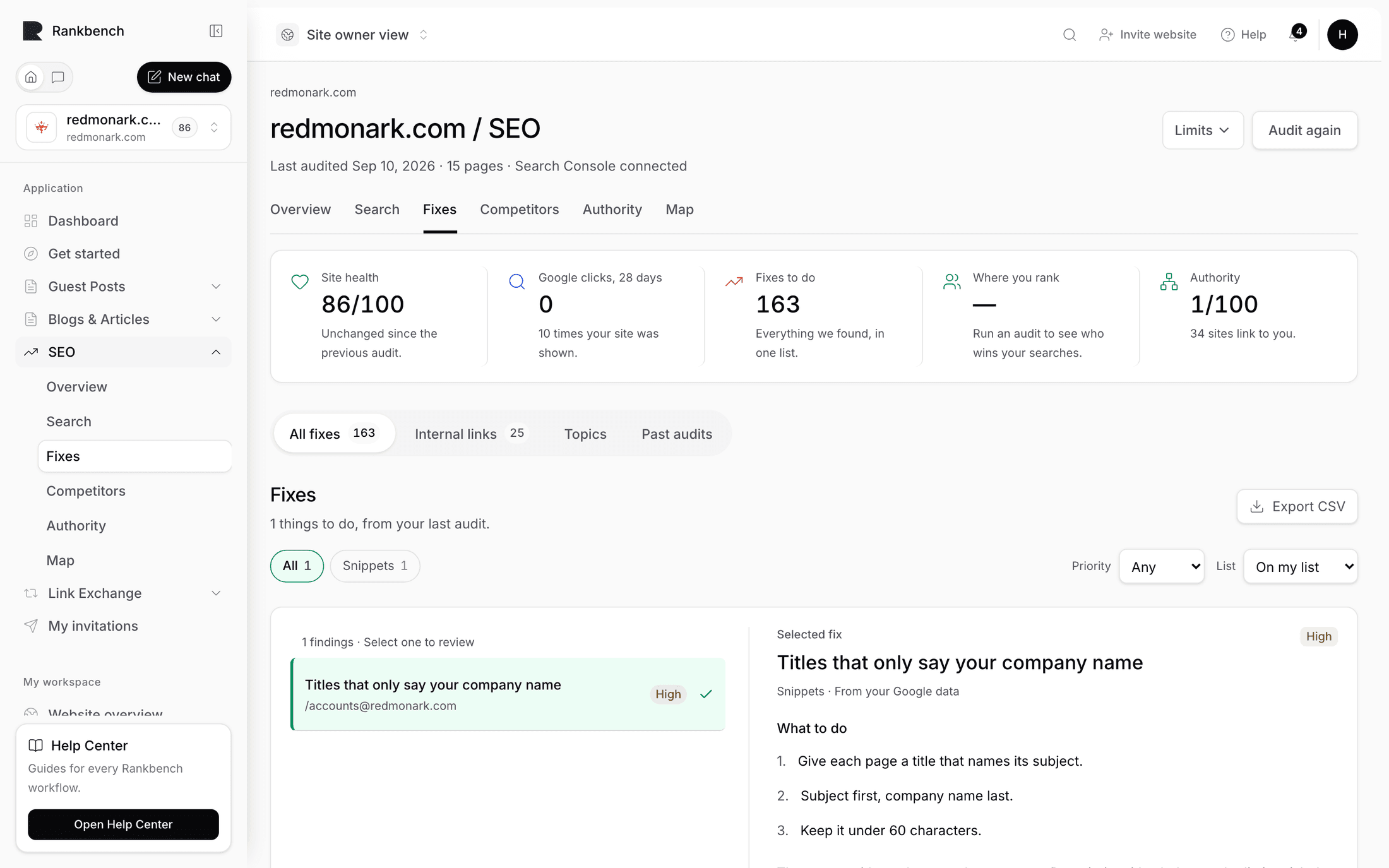
Your fix list is the page that holds work you've decided to do. Its description: "The changes you approved, waiting to be made on your own site. Mark one done and Rankbank re-reads the page to confirm the link really appeared."

Two things land here, and nothing else:

  • Findings you accepted. Pressing Add to my fix list on any finding card moves it here. See findings: how to read a card.
  • Link suggestions you approved. Pressing Add to my fix list on a suggested internal link approves it and creates the task in one step. See suggested links.

Structural problems from the Problems to fix page do not come here. They have their own simpler loop: fix, mark I fixed this, read the site again.

The six statuses

Six tiles run across the top, and each one is a filter. Tap a tile to see only those, or use the show everything link underneath to clear it. A tile only appears when it has something in it.

TileWhat it means
To do"Waiting for you to make the change."
In progress"You marked these as started."
Done, checking"You made the change; we are confirming it."
Confirmed"We re-read the page — the link is really there."
Not found"We looked, and the link was not on the page."
Almost"The link exists but with different wording or placement."

Almost is the useful one. It means Rankbank found a link from the right page to the right page, but the wording or the placement isn't what the task asked for. That's usually fine. If you linked with better words than the suggested ones, or put the link in a different paragraph, the change still did its job. The status exists so you can tell the difference between "not done" and "done differently", which are very different things.

Your fix list with tasks in several different statuses
Tiles at the top double as filters. The lists underneath are grouped by where the work came from.

The two lists

Findings you accepted

Headed Findings you accepted, with the note "Make each change on your site, then mark it done. The AI prompt on each one writes the text for you."

Each entry is the full finding card again, with everything it had on the Overview: severity badge, evidence, what it's worth, the Why this matters, and how to fix it disclosure, and the Copy AI prompt button. Underneath each card is one extra control, I've made this change.

That's the whole loop for accepted findings. Make the change on your site, come back, press the button.

The Copy AI prompt button is worth using here rather than on the Overview, because this is the page you'll have open while you're actually doing the work. The prompt has your page's real title, description and search queries baked into it, so pasting it into ChatGPT or Claude produces something usable on the first try. Nothing AI-driven runs inside Rankbank. The prompt is text for you to take elsewhere.

The changes

Headed The changes, with the note "Make each one on your site, then tell us — we re-read the page to confirm."

These are internal-link tasks. Each row leads with the two pages involved, written as {source} → {target}, with a status chip beside them, then the instruction in one sentence:

On Pricing (/pricing), add a link to Enterprise plans (/enterprise) using the words "enterprise plans".

Pages are named rather than titled, on purpose. A site where every page carries the same title would otherwise produce rows reading "Acme Ltd → Acme Ltd", which tells you nothing about either end.

Two more lines appear when they exist. Our check: {reason} is what Rankbank found when it last looked at the page, which is where you'll see why something landed in Not found or Almost. Your note: {note} is whatever you typed for yourself.

The check-back loop

This is the part that makes the fix list worth keeping rather than a to-do list you'd have written anyway.

  1. You make the change on your own site. Rankbank never touches your pages.
  2. You press Done — check the page.
  3. Rankbank fetches that page and looks for the link: does it exist, does it point at the right target, and does it use the words the task asked for?
  4. The task moves to Confirmed, Not found, or Almost, and Our check explains what it saw.

There's also I've started if you want to mark something in progress before you've finished it, useful when you're working through a batch across a few days. The note field, placeholder "Optional note to your future self.", saves alongside either action.

If a task lands in Not found and you're sure you made the change, the usual causes are caching, a change that didn't deploy, or a link added to a draft rather than the published page. Check the live page in a private browser window first, then press Done — check the page again.

The empty state

Before anything lands here you get Nothing on your list yet: "Accept a finding on your site's overview, or a suggested link, and it lands here as a change to make."

That's the honest description of how work arrives. Nothing is added automatically, and there's no queue building up behind the scenes. The fix list only ever contains things you said yes to.

Where the work comes from

If your fix list is empty and you want it not to be, there are three doors:

  • Do these three next on your site's Overview, which shows the highest-value findings first
  • The growth plan, which groups every priced finding into five sections
  • Suggested links, which proposes internal links with the evidence behind each one

The header of this page has an Overview button and a Suggested links button for exactly that reason.

← Every problem type, explainedFindings: how to read a card →

Still stuck?

Open Rankbank and the page this article describes — most screens explain themselves as you go.

On this page

The six statusesThe two listsFindings you acceptedThe changesThe check-back loopThe empty stateWhere the work comes from
Rankbank — Editorial collaborationOpen RankbankHelp home