
Competitors
Updated · First published
The Competitors tab answers a question the rest of the module cannot: not what is wrong with your site, but who is beating you and with what.
It is described as "Who ranks for the searches you want, how much traffic they get, and what they rank for that you do not."
Where it comes from
The audit works it out. When it reads your site it also looks up who else ranks for the same searches, in the country your site actually serves, and takes a snapshot.
That means it is only as fresh as your last audit, and a site that has never been audited sees an empty tab with instructions rather than a blank page.
Your estimated search traffic
A twelve-month view of what your site is estimated to earn from search, with the honest caveat attached: "Estimated from what they rank for, not from your analytics."
This is worth reading carefully. It is a model, not a measurement. It works out roughly what traffic a site should get given what it ranks for and where, and it applies the same model to you and to everyone you are compared against. That is what makes the comparison fair, and it is also why the number will not match your own analytics.
Your real numbers live on the Search tab, measured by Google.
Who you are up against
The sites ranking for the searches you want, on the same scale as you.
They are chosen by overlap, not by opinion: sites appearing for the same searches. Sites wildly out of your league are filtered out, because comparing a five-page site with a national newspaper produces a chart nobody can act on. Where sites were dropped for scale, the page says how many, so a count of comparable sites does not read as a count of every site in your field.
Searches you do not rank for
The keyword gap: searches your closest competitor ranks for and you do not.
Each one is counted in the country your site serves, which the page names, with the competitor in the top twenty and your site nowhere. Their own brand name is left out, because nobody can take "hubspot" from HubSpot, and so are one-word searches, which are almost always somebody's product name. The total at the top counts by the same rule as the list underneath it.
This is the most directly useful part of the tab, because it is a writing list. Each row is a search with demand that somebody in your field is already answering and you are not.
Two cautions. Not every gap is worth filling; some belong to a business you are not in. And the gap is a list of searches, not of articles, so several rows often collapse into one good page.
The way to act on one is to hand it to the calendar. See refreshing your topics.
Your pages that earn the most
The same estimate applied to your own pages, so you can see which ones the model thinks are carrying the site.
Useful for a sanity check against the Search tab: where the model and Google disagree sharply about a page, that page is usually worth a look.
Your company
The overview carries a card of what company profiles published on the web say about your business, read once when the site was first audited and described as changing slowly enough to look up once rather than every time. None of it comes from a company registry.
Refreshing it needs Pro and a reading over ninety days old.
When it is empty
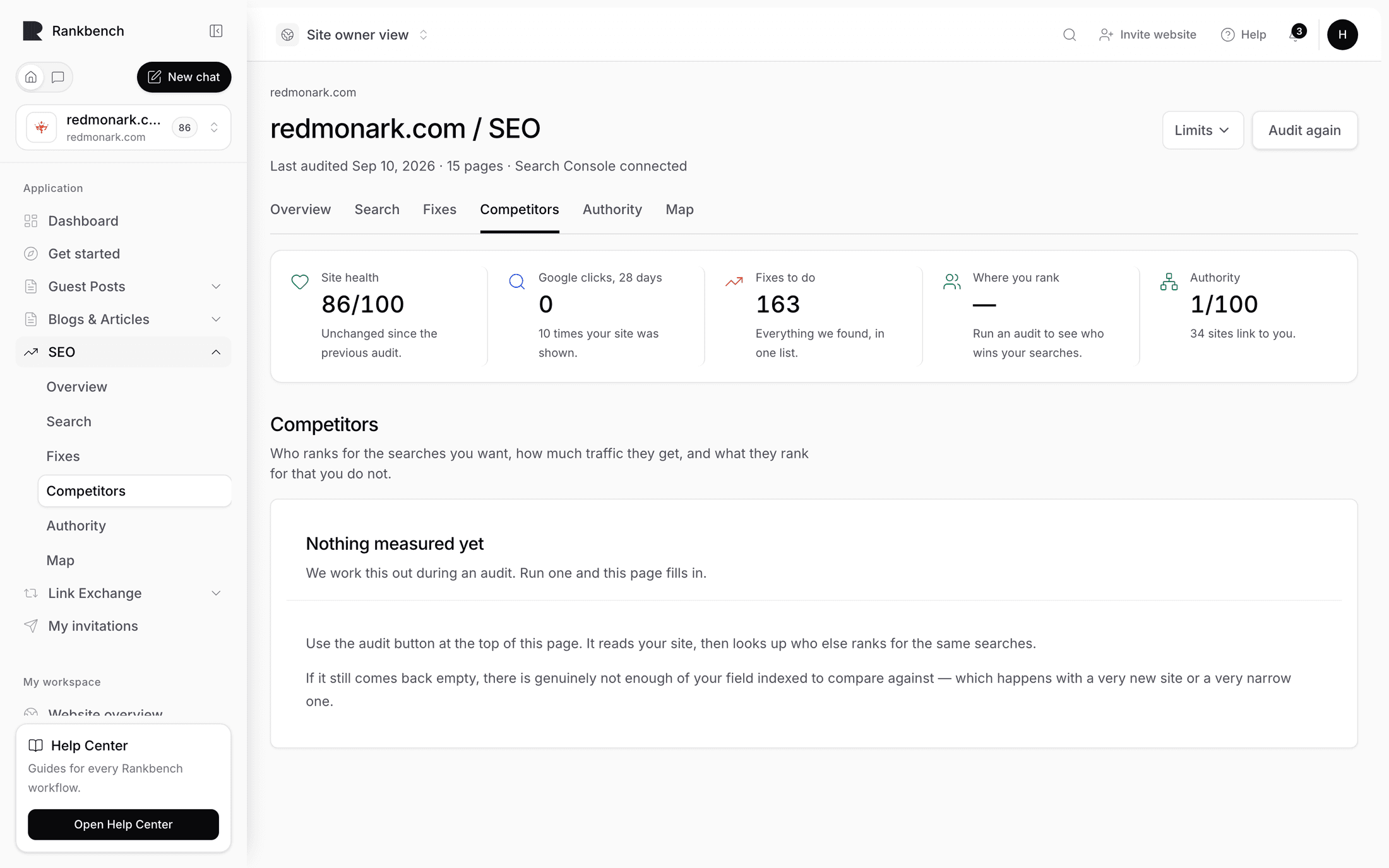
"Nothing measured yet", and underneath, "We work this out during an audit. Run one and this page fills in."
If it is still empty after an audit, the page is honest about why: there may genuinely not be enough of your field indexed to compare against, which happens with a very new site or a very narrow one.
Where to go next
The Search tab is your own measured data. Authority is the other half of why a competitor outranks you.
Still stuck?
Open Rankbench and the page this article describes — most screens explain themselves as you go.