Opening Rankbank0.0s
Getting startedCreating your Rankbank accountAdding your first websiteProving your site is yoursWriter view and Site owner viewHow Rankbank tells you thingsYour dashboardRankbank Pro and billing
Site audit & search growthThe SEO overview, explainedHow Rankbank reads your siteThe site health scoreThe Problems to fix pageEvery problem type, explainedYour fix listFindings: how to read a cardEverything Rankbank looks forThe map of your siteConnecting Google Search ConsoleThe growth planSuggested linksTopics and content ideasAuthority: how much weight your site carriesThe Search traffic pagePast reads and history
Guest postsGuest posting on RankbankSubmitting your first guest postImporting from Google DocsWriting in the Rankbank editorReview & send: the last step before the editorsWhen the editors ask for changesTracking your guest postsFor site owners: opening your site to guest postsFor site owners: writing your guidelinesFor site owners: reviewing a submissionFor site owners: publishing and the live checkThe Content Library
Link exchangeLink swaps on RankbankSetting up your site for swapsPages you shareFinding a site to swap withSending a swap requestReviewing a swap request you receivedAsking a partner for a linkAnswering a link requestWhen the page is published somewhere you can't editHow Rankbank keeps watchThe partner ledger
Content calendarThe content calendarSetting up your calendarWhere the keywords come fromReading the calendarSteering an article before it's writtenReviewing and editing a draftConnecting where it publishesPublishing and what happens nextStyle & settings
TutorialsYour first site audit, from "read my site" to fixes you can ship this weekConnecting Search Console and turning its data into clicksWriting a guest post that gets accepted, the full pathRunning guest posts on your site without letting quality slipYour first link swap, start to finishKeeping your links alive, from wording changes to missing linksA month of content on autopilot, done properly
RankbankHelp center
Open Rankbank →
Getting startedCreating your Rankbank accountAdding your first websiteProving your site is yoursWriter view and Site owner viewHow Rankbank tells you thingsYour dashboardRankbank Pro and billing
Site audit & search growthThe SEO overview, explainedHow Rankbank reads your siteThe site health scoreThe Problems to fix pageEvery problem type, explainedYour fix listFindings: how to read a cardEverything Rankbank looks forThe map of your siteConnecting Google Search ConsoleThe growth planSuggested linksTopics and content ideasAuthority: how much weight your site carriesThe Search traffic pagePast reads and history
Guest postsGuest posting on RankbankSubmitting your first guest postImporting from Google DocsWriting in the Rankbank editorReview & send: the last step before the editorsWhen the editors ask for changesTracking your guest postsFor site owners: opening your site to guest postsFor site owners: writing your guidelinesFor site owners: reviewing a submissionFor site owners: publishing and the live checkThe Content Library
Link exchangeLink swaps on RankbankSetting up your site for swapsPages you shareFinding a site to swap withSending a swap requestReviewing a swap request you receivedAsking a partner for a linkAnswering a link requestWhen the page is published somewhere you can't editHow Rankbank keeps watchThe partner ledger
Content calendarThe content calendarSetting up your calendarWhere the keywords come fromReading the calendarSteering an article before it's writtenReviewing and editing a draftConnecting where it publishesPublishing and what happens nextStyle & settings
TutorialsYour first site audit, from "read my site" to fixes you can ship this weekConnecting Search Console and turning its data into clicksWriting a guest post that gets accepted, the full pathRunning guest posts on your site without letting quality slipYour first link swap, start to finishKeeping your links alive, from wording changes to missing linksA month of content on autopilot, done properly
  1. Help center
  2. /
  3. Link exchange
  4. /
  5. Setting up your site for swaps

Setting up your site for swaps

Updated August 24, 2026


Before your site can send or receive swap requests, it has to satisfy four conditions. Rankbank checks them for you and names the ones you are missing, so you do not have to guess. This page walks through all four, then through the rules you set for partners.

Everything here lives on one page: Website Link Exchange Settings, at /admin/settings/websites/{id}/link-exchange. Open it from Websites in the admin section, or from any blocker message that offers a fix button.

The Website Link Exchange Settings page showing the verification, website, and collaboration access cards
One page holds all four requirements: verification, site details, the collaboration switches, and your guidelines.

1. Prove the site is yours

The first card on the page is titled Prove this site is yours, and it explains why: "Partners can only swap with verified sites. Four ways to prove it — whichever is easiest for you."

The four methods are a meta tag on your homepage, a small text file, a DNS TXT record, and Google Search Console. Press Check my site and Rankbank tries all four at once. Any single one passing is enough. The full walkthrough, including what each result message means, is in proving your site is yours.

Once it passes, the card renames itself to Verification and says "Verified — {domain} is yours." with the line "Confirmed through {method}. Partners and audits treat this site as trusted."

Warning

Verification is not a one-time formality. If the tag, file, or record is later removed, the site can lose its verified state and you will get an A site lost its verification notification. A site that is not verified drops out of the directory and cannot send swap requests.

2. Turn on link swaps

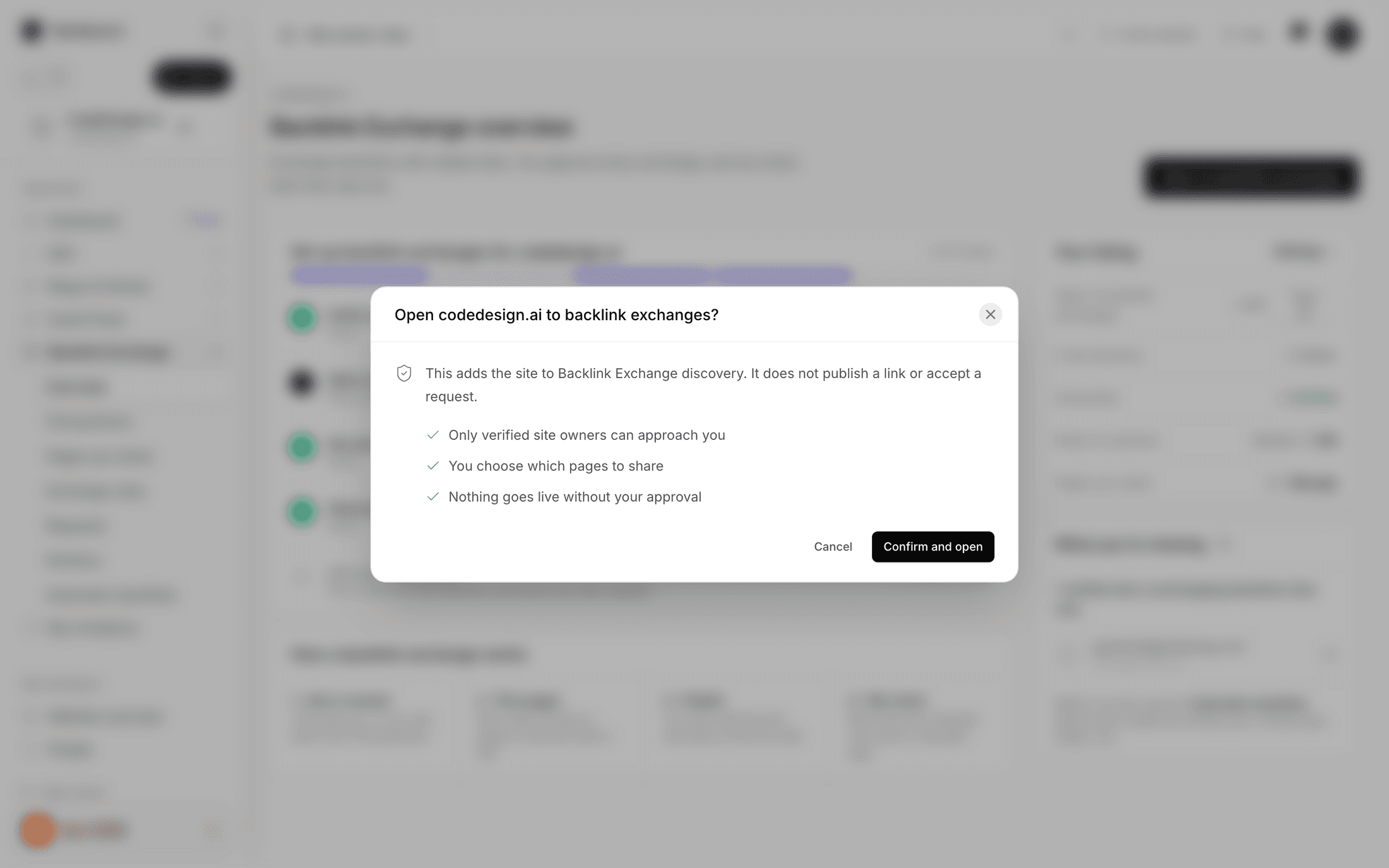
In the Collaboration access card there are three switches: Accept Guest Posts, Accept Link Exchanges, and Accept Paid Collaborations. The card explains what they do: "These controls decide whether this website appears as eligible for exchange requests."

Turn on Accept Link Exchanges. That single switch is what makes the site eligible in both directions. Leave it off and Rankbank tells anyone who picks your site "Your site isn't open to link swaps yet."

Accept Paid Collaborations is optional and independent. Turning it on adds the line Paid Collaboration Available to your directory card. Rankbank does not handle money; the line simply tells other owners you are open to that conversation.

3. Set visibility to Public

Just under the switches is a Visibility select with four values, and only one of them puts you in the directory.

  • Public: your site appears in Opportunities and anyone can send you a swap request.
  • Private: the default. You can still send requests; nobody finds you by browsing.
  • Invite Only: out of the directory; requests come from people you have already pointed at your site.
  • Paused: out of the directory while you catch up on the requests you already have.

If you are new here, the honest sequence is: get verified, set your rules, then flip visibility to Public. A public card with no rules behind it will not appear anyway, which is the next requirement.

4. Save your guidelines at least once

The Guidelines card is where you tell partners what you accept. It carries one important sentence: "Each save creates a new active guideline version. Existing requests keep their acknowledged snapshot."

That is the whole versioning model. Published versions are never rewritten. When you change a rule, Rankbank makes a new version and marks the old one Previous version in the Guideline status and history list at the bottom of the page. Anyone who already sent you a request is still measured against the version they read and ticked, not the one you saved this morning.

Until you save once, your site has no active guideline version, and a site with no active version does not appear in the directory. Anyone who picks you as a target sees "Their site isn't fully set up for swaps yet."

The Guidelines card with the authority and referring-domains minimums, anchor policy, and expected review days
Every save publishes a new version. Requests in flight keep the version they agreed to.

The fields that actually do something

The guidelines form is long. Most of the fields are prose that partners read; two of them are enforced by the system, and one changes what your directory card says. Those three are worth deliberate thought.

Minimum Authority Score. A number out of 100. If a site's authority is below it, Rankbank blocks the pairing and says so in figures: "Your Site Rank {n} is below the required {m}". This gate is checked in both directions, which surprises people. Setting a high bar filters who may ask you, and it also stops you from asking sites whose own bar you do not clear. Leave it empty if you would rather judge each request yourself.

Minimum Referring Domains. The same idea, counted in how many distinct sites link to a domain rather than in a score. Variety is the more honest signal of the two, since a thousand links from one site is one relationship.

Expected review days. This becomes the line "Usually replies in {n} days" on your directory card, and it is one of the filters other owners can search on. Put a number you can actually keep. It sets an expectation about you, not about Rankbank.

The rest are read by humans rather than enforced by code. Accepted topics and Restricted topics are shown to a requester on the Their rules card right before they send, so naming the subjects you never take saves you from the pitches you were always going to refuse. Anchor-text policy appears there too, as "Link text: …". Allowed countries and Allowed languages narrow who qualifies; leave them empty if all are acceptable. Contextual links only is on by default and states the obvious preference that links belong inside sentences rather than in a list at the bottom of a page. Additional instructions is the free-text catch-all, and it is shown to requesters verbatim.

Monitoring days defaults to 180 and describes how long you expect a placed link to stay up. Expected publication days sets the same kind of expectation for how quickly you place a link after agreeing to it.

Press Save Link Exchange settings when you are done. The confirmation reads "Settings saved — Website guidelines were versioned."

Checking your own work

The quickest way to confirm all four conditions are met is to try to use them. Open Opportunities, pick any site, and press Ask to swap links. If your side is not ready, the page shows a panel titled Not yet — here's what's in the way and names each missing piece with a button that goes straight to the fix. Sending a swap request covers every blocker message in that panel.

One more thing is needed before you can actually send: at least one shared page. That is the subject of pages you share.

← Link swaps on RankbankPages you share →

Still stuck?

Open Rankbank and the page this article describes — most screens explain themselves as you go.

On this page

1. Prove the site is yours2. Turn on link swaps3. Set visibility to Public4. Save your guidelines at least onceThe fields that actually do somethingChecking your own work
Rankbank — Editorial collaborationOpen RankbankHelp home